Solar Panel Sizing for Home Use: How Many Panels Do You Actually Need?
Imagine a bill showing 300 kilowatt-hours for the month and three solar quotes that disagree wildly: six panels from one company, fourteen from another, and a promise from a third that the bill will vanish. All three can look reasonable until you know what goes into the sum.
A classic mistake is sizing the array to the raw kilowatt-hours on the bill. Heat, dirty glass, wiring and inverter losses typically take around a quarter of the nameplate output, so a system sized with no allowance for them never quite delivers what the sum promised. The sizing itself is short arithmetic, and you can do it yourself.
This guide walks through it in order: your daily energy use, your local Peak Sun Hours, a realistic loss factor, the panel count, a roof-area check, and a cold-weather voltage check on the strings.
Contents in this Guide
- The Sizing Formula in Plain English
- Safety and Reality Check First
- Step 1: Find Your True Daily Energy Demand (Wh)
- Step 2: Calculate Array Size and Panel Count
- What Your Roof and Climate Do to the Numbers
- Panel Technologies and Datasheet Numbers That Matter
- Will the Strings Fit Your Inverter? (Cold Voc Sanity Check)
- Grid-Tied, Hybrid, or Off-Grid: How Sizing Changes
- Common Sizing Mistakes That Cost You Money
- Live Panel Count Estimator & Quiz
- Related ElectroLab Calculators & Engineering Tools
- Frequently Asked Questions
The Sizing Formula in Plain English
Every quote, however it is dressed up, starts from one equation:
The Solar Array Sizing Formula
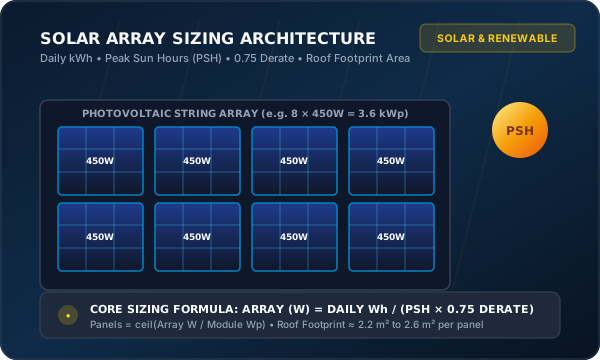
Array Size (Watts) = (Daily Energy Requirement (Wh)) / (Peak Sun Hours (PSH) × System Derate Factor)
Divide the array size by the wattage of the module you plan to use and round up: Panel Count = ⌈Array Size / Panel Wattage⌉.
What "Peak Sun Hours" Really Means (It Is Not Daylight Hours)
It is tempting to count the twelve hours between dawn and dusk and assume twelve hours of generation. But the sun is low at 8:00 AM, strong at 1:00 PM and weak again by 6:00 PM, so most of the energy arrives in a few midday hours.
To make this manageable, the day's sunlight is expressed as Peak Sun Hours (PSH). One Peak Sun Hour is the energy you would get from 1,000 watts per square meter (1 kW/m2) shining for exactly one hour, which is 1 kWh/m2.
Annual averages run from roughly 3 to 6.5 PSH per day depending on latitude and climate. Northern Europe and the UK sit around 2.5 to 3.5 over the year and can fall below 1.5 in December. The southern US, Mediterranean Europe, Australia and much of India often see 4.5 to 6.5. Look up your own location in a database such as NASA POWER or PVGIS instead of guessing.
Why a 550 W Panel Never Makes 550 W
The wattage printed on a panel is measured under Standard Test Conditions (STC): 1,000 W/m2 of light, an AM 1.5 spectrum and a cell temperature of 25°C (77°F). A real roof rarely matches that.
On a sunny afternoon with 30°C air, dark silicon cells run at around 55°C to 65°C. Silicon loses power as it heats: roughly 0.30% to 0.38% for every degree above 25°C. Add dust on the glass, cable resistance, small mismatches between modules and inverter conversion losses, and the whole system ends up with a derate factor between about 0.70 and 0.85.
For planning, 0.75 is a sensible, slightly cautious default, and it is what the examples below use. If the system does better, you have some spare margin. A factor of 1.0 is never realistic.
Safety and Reality Check First
Panels produce DC the moment light hits them, and there is no switch on the panel itself. A string of ten modules can reach 400 to 500 V DC. Because DC never crosses zero, an arc can sustain itself and start a fire in roof framing. Falls from roofs are also a major source of serious injury in solar work. This guide covers sizing arithmetic only. Mounting, DC wiring and connection to the main service panel should be done by licensed, insured installers, in line with your local electrical code and utility rules.
Doing the sizing yourself lets you judge installer proposals and avoid paying for panels you do not need. It does not replace a structural check of the roof, building permits or your utility's interconnection approval, all of which depend on where you live.
Step 1: Find Your True Daily Energy Demand (Wh)
Panels cannot be sized until you know how much energy you use in a day. There are two ways to get that number.
Method A: From Your Monthly Electricity Bill
For an existing grid-connected home, collect the last twelve months of bills and note the kilowatt-hours (kWh) used each month:
Daily kWh = (Monthly kWh) / 30
If you are grid-tied with net metering, use the average month, since summer cooling and winter heating tend to even out. Without net metering, or off-grid, use the busiest month or the darkest winter month, so the system copes when conditions are worst.
Method B: From an Appliance Audit List
For a cabin, workshop or backup circuit there may be no bills to read, so list each appliance and multiply its wattage by the hours it really runs. Cycling loads need care. A refrigerator rated at 150 W does not draw that for 24 hours; the compressor switches on and off, which works out to roughly 6 to 8 hours of full-power running in a day.
| Appliance Description | Quantity | Rated Watts (W) | Daily Runtime (Hours) | Daily Energy (Wh/day) |
|---|---|---|---|---|
| Warm-White LED Lighting | 10 | 9 W | 5.0 hours | 450 Wh |
| High-Efficiency Ceiling Fans | 3 | 60 W | 8.0 hours | 1,440 Wh |
| LED Smart Television | 1 | 100 W | 5.0 hours | 500 Wh |
| Domestic Refrigerator (Cyclic Compressor) | 1 | 150 W | 8.0 hours (equivalent) | 1,200 Wh |
| Workstation Laptop & Charger | 1 | 60 W | 6.0 hours | 360 Wh |
| Fiber Internet ONT & Wi-Fi Router | 1 | 10 W | 24.0 hours | 240 Wh |
| Front-Load Washing Machine (Cold Wash) | 1 | 500 W | 1.0 hour | 500 Wh |
| Total Daily Consumption Demand | 4,690 Wh (4.69 kWh) | |||
Got Your Daily Wh? Run the Solar Panel Sizer
Enter your daily kilowatt-hours and local peak sun hours to get the array wattage and panel count from the Solar Array Sizing Calculator.
Step 2: Calculate Array Size and Panel Count
With daily demand and a derate factor in hand, the rest is division. Here are three worked cases.
Worked Example A: Sizing for the Appliance Audit (4,690 Wh/day)
Assume 5.0 Peak Sun Hours and a derate factor of 0.75:
Array Size = (4,690 Wh) / (5.0 PSH × 0.75) = 4,690 / 3.75 ≈ 1,250.7 Watts
With 450 W modules:
Panels Needed = (1,250.7 W) / (450 W) = 2.78, so round up to 3 panels (1,350 Wp array)
Expected daily production: 1,350 W × 5.0 PSH × 0.75 = 5,062.5 Wh/day, about 7.9% above the 4,690 Wh needed.
Worked Example B: The 300 kWh/Month Utility Bill
The bill says 300 kWh for the month. Divided by 30 days, that is 10.0 kWh (10,000 Wh) per day. Assume a moderate 4.0 PSH and a 0.75 derate factor:
Array Size = (10,000 Wh) / (4.0 PSH × 0.75) = 10,000 / 3.0 ≈ 3,333.3 Watts
With 450 W panels: 3,333.3 / 450 = 7.41, so round up to 8 panels (3,600 Wp array).
Expected daily generation: 3,600 W × 4.0 PSH × 0.75 = 10,800 Wh/day (about 324 kWh per 30-day month).
Worked Example C: Daily Generation from a Single 550 W Panel
How much energy does one 550 W module produce where there are 5.0 PSH?
Daily Output = 550 W × 5.0 PSH × 0.75 = 2,062.5 Wh/day (2.06 kWh)
Over a 30-day month, that one panel contributes about 61.9 kWh.
Should You Target 100% Offset?
Some proposals aim for 100% or even 105% of your bill. That can make sense where the utility credits exports one-for-one. Where export rates are low, tariffs vary by time of day or exporting is restricted, extra midday power you can neither use nor store earns little or nothing.
For a grid-tied system with no battery, covering 70% to 85% of your usage often pays back better, because more of what you generate is used at home. Off-grid is the opposite. Size for the worst month (usually December or January in the Northern Hemisphere) and plan a backup generator for long stretches of poor weather.
| Daily Energy (kWh) | Local PSH | Derate | Array Size (Wp) | Panels at 450 W | Panels at 550 W | Expected Generation (Wh) |
|---|---|---|---|---|---|---|
| 3.0 kWh (Cabin / Tiny Home) | 3.5 PSH | 0.75 | 1,143 W | 3 panels (1,350 W) | 3 panels (1,650 W) | 3,544 Wh / 4,331 Wh |
| 4.69 kWh (Efficient House) | 5.0 PSH | 0.75 | 1,251 W | 3 panels (1,350 W) | 3 panels (1,650 W) | 5,063 Wh / 6,188 Wh |
| 6.0 kWh (Modest Home) | 4.0 PSH | 0.75 | 2,000 W | 5 panels (2,250 W) | 4 panels (2,200 W) | 6,750 Wh / 6,600 Wh |
| 10.0 kWh (300 kWh/month) | 4.0 PSH | 0.75 | 3,333 W | 8 panels (3,600 W) | 7 panels (3,850 W) | 10,800 Wh / 11,550 Wh |
| 15.0 kWh (Suburban Family) | 4.5 PSH | 0.75 | 4,444 W | 10 panels (4,500 W) | 9 panels (4,950 W) | 15,188 Wh / 16,706 Wh |
| 20.0 kWh (Family with EV) | 5.0 PSH | 0.75 | 5,333 W | 12 panels (5,400 W) | 10 panels (5,500 W) | 20,250 Wh / 20,625 Wh |
| 30.0 kWh (Heavy Heating/AC) | 5.5 PSH | 0.75 | 7,273 W | 17 panels (7,650 W) | 14 panels (7,700 W) | 31,556 Wh / 31,763 Wh |
What Your Roof and Climate Do to the Numbers
The formula assumes an unshaded surface angled well toward the sun. Real roofs have trees, chimneys and whatever slope the builder chose.
Tilt Angle and Azimuth Direction
As a rule of thumb, face the array true South in the Northern Hemisphere or true North in the Southern Hemisphere, toward the equator.
The best year-round tilt is close to your latitude, often a little less. At 35° latitude, something between 25° and 35° captures most of the available yearly energy. An east- or west-facing roof is not a dealbreaker: due west typically yields roughly 80% to 88% of a south-facing array, and west-facing panels can suit places where evening electricity costs the most.
Shading: The String Killer
A series string behaves like a garden hose: step on one section and the flow drops everywhere. When one panel is shaded by a dormer, its current falls, and the whole string is pulled down toward that lower current unless the bypass diodes step in.
If shade from trees or vents is unavoidable, ask about module-level power electronics (MLPE), meaning DC optimizers or microinverters. They let each panel work independently, so shade on one module costs little elsewhere.
Roof Area Check (Worked Example D)
Before settling on a panel count, check that it fits. A typical 550 W module measures roughly 2.28 m × 1.13 m ≈ 2.58 m2 (27.8 sq ft).
- 4 Panels: 4 × 2.58 m2 ≈ 10.3 m2 (111 sq ft)
- 10 Panels (5.5 kW Array): 10 × 2.58 m2 ≈ 25.8 m2 (278 sq ft)
You cannot cover the whole roof. Many fire codes require setbacks of about 0.9 m (3 ft) along ridges and edges so firefighters can walk the roof, though the exact figure depends on your jurisdiction. Subtract valleys, vent pipes and shaded corners before counting usable area.
| Environmental Factor | Typical Output Impact | What You Can Do About It | Notes |
|---|---|---|---|
| Summer Roof Heat | -10% to -18% loss | Ensure minimum 10 cm (4 in) air gap under panels | Monocrystalline TopCon cells have lower temp coefficients (-0.30%/°C). |
| Dust & Soiling | -3% to -8% (up to -25% in arid deserts) | Periodic hose rinsing; rely on rainfall in temperate climates | Pitched roofs (>10°) self-clean during moderate rainstorms. |
| Partial Shading | -15% to -50% on series strings | Trim tree branches; install DC optimizers or microinverters | Even a narrow powerline shadow across cells can trigger bypass diodes. |
| Off-Angle Azimuth (East/West roofs) |
-12% to -20% vs. true South/North | Add a panel or two if the roof has room | West-facing panels produce more in the late afternoon, when grid demand is high. |
| Annual Degradation | -0.4% to -0.5% per year | Account for year-10 output during initial sizing | Many N-type panels carry warranties of about 87% of nameplate power at year 30. |
Panel Technologies and Datasheet Numbers That Matter
Datasheets are full of abbreviations. These are the ones that affect sizing.
Mono PERC vs. TOPCon vs. Polycrystalline
Older blue polycrystalline panels (15% to 17% efficient) have largely disappeared from new home installs. The current mainstream is P-type Mono PERC (about 20% to 21.5%) and the newer N-type TOPCon (about 22% to 23%). TOPCon modules generally have a better temperature coefficient and degrade more slowly, which helps in hot climates.
| Datasheet Specification | What the Number Measures | Why You Care in Sizing |
|---|---|---|
| Pmax (Rated Power) | Peak output under laboratory STC (1,000 W/m2, 25°C) | The baseline wattage used to calculate total panel count. |
| Voc (Open-Circuit Voltage) | Maximum voltage produced with no electrical load attached | Safety limit: the cold-weather string total must stay below the inverter or controller maximum DC input. |
| Vmp (Maximum Power Voltage) | Voltage when the panel is delivering peak power under load | Must sit comfortably within the inverter MPPT operating tracking window. |
| Isc (Short-Circuit Current) | Maximum current produced when output terminals are shorted | Determines DC isolator switch ratings and wire ampacity sizing. |
| Imp (Maximum Power Current) | Operating current when delivering peak power under load | Must not exceed the maximum input current per MPPT tracker. |
| Temp. Coeff. of Pmax | Percentage power lost for every 1°C increase above 25°C | Tells you how badly output will drop on hot summer afternoons. |
| Temp. Coeff. of Voc | Voltage increase percentage for every 1°C temperature drop | Required to calculate cold-weather maximum string voltage. |
Will the Strings Fit Your Inverter? (Cold Voc Sanity Check)
Panels in series add their voltages, so a string cannot be made arbitrarily long. If the total exceeds the maximum DC input of your inverter or MPPT charge controller, the unit can be damaged.
What catches people out is that voltage rises as temperature falls. A panel rated at 49.5 V at 25°C will produce about 53 V on a 0°C morning.
Worked Example E: Cold-Weather Voc Calculation
Take a 550 W panel with an open-circuit voltage (Voc) of 49.5 V at 25°C and a Voc temperature coefficient of -0.27%/°C. Suppose the coldest expected temperature is 0°C, a 25°C drop:
Voltage Rise = 25°C × 0.27% = 6.75%
Voc(cold) = 49.5 V × (1 + 0.0675) = 49.5 × 1.0675 ≈ 52.84 V
Now suppose the MPPT charge controller allows a maximum of 150 V DC input:
Max Series Panels = (150 V) / (52.84 V) = 2.84, so at most 2 panels in series
Three of these panels in series would reach 3 × 52.84 V = 158.5 V on a 0°C morning, over the limit, and the controller could be damaged. Use the coldest temperature your site can reach, not the average.
Series versus parallel: panels in series add voltage while the current stays that of one panel (Vstring = V1 + V2). Strings in parallel keep the voltage and add current (Iarray = I1 + I2). For inverter surge ratings and battery sizing, see the companion guide: How to Calculate Solar Inverter and Battery Bank Capacity.
Grid-Tied, Hybrid, or Off-Grid: How Sizing Changes
The right array size depends on how the system connects to the grid.
| System Architecture | How You Size the PV Array | The Biggest Sizing Trap | Recommended Next Step |
|---|---|---|---|
| Grid-Tied (No Battery) | Size to match 70% to 100% of average annual billing kWh. | Oversizing when the utility pays little or nothing for exports. | Check your local utility interconnection rules. |
| Hybrid (Grid + Battery) | Size to cover daytime loads PLUS daily battery recharge capacity. | Undersizing the array so the batteries rarely fill in winter. | Explore our Inverter & Battery Sizing Guide. |
| Off-Grid (Standalone) | Size for the worst solar month, with a buffer for cloudy days. | Sizing for summer sun, then running short in November and December. | Plan a backup generator and a generous battery bank. |
Common Sizing Mistakes That Cost You Money
Check a quote against these nine errors before you sign:
- Using Raw Utility Bill kWh Without a Derate Factor: Heat, dirt and wiring losses can take around 25% of nameplate output.
- Confusing Daylight Hours with Peak Sun Hours: Multiplying panel watts by twelve hours of daylight instead of, say, 4.5 Peak Sun Hours.
- Sizing for the Best Month on an Off-Grid System: Sizing a cabin for July sun leaves it short in December.
- Ignoring Partial Shading from Chimneys or Trees: Running plain series strings across roofs that get partial shade from trees.
- Overlooking Cold-Weather Voc Rise: Skipping the temperature coefficient and exceeding the inverter input limit on cold mornings.
- Forgetting Local Fire-Code Roof Setbacks: Laying out panels to the roof edge, then failing inspection for blocking access pathways.
- Assuming a 550 W Panel Generates 550 W All Day: Expecting laboratory STC output from cells running at 60°C or more.
- Oversizing the Array Beyond Inverter MPPT Limits: A modest oversize is normal, but a large one means the inverter clips the peaks.
- Skipping an On-Site Physical Roof Survey: Accepting a satellite-photo quote without checking rafter condition or the capacity of the electrical service panel.
Live Panel Count Estimator & Quiz
Try your own numbers in the estimator, then check your understanding with the short quiz.
Interactive Solar Panel & Roof Area Estimator
*Calculated values use Array (W) = Daily Wh / (PSH × Derate). Roof area estimate assumes 2.2 m2 per 450W panel and 2.58 m2 per 550W panel.
Solar Panel Sizing Quiz
Test your sizing judgment against practical design questions. Click an answer for immediate feedback.
Frequently Asked Questions
How many solar panels do I need to run a house?
A home using 20 to 30 kWh per day with 4.0 to 4.5 Peak Sun Hours and a 0.75 derate factor needs roughly 14 to 23 panels of 450 W. Your own count depends on daily energy use, seasonal sun, roof orientation, and whether the system is grid-tied or off-grid.
How many solar panels do I need for 300 kWh a month?
300 kWh per month is 10 kWh (10,000 Wh) per day. With 4.0 Peak Sun Hours and a 0.75 derate factor you need about a 3,333 W array. With 450 W panels that rounds up to 8 panels (3,600 W), producing roughly 10,800 Wh per day.
How many watts is a solar panel actually producing in real conditions?
A 550 W rating applies only under Standard Test Conditions (STC), and a hot roof seldom matches them. Cell temperatures of 50°C to 65°C cut output by roughly 10% to 15%. With soiling, wiring and inverter losses on top, a healthy 550 W panel typically delivers about 400 W to 440 W at clear midday.
What are Peak Sun Hours and how do they differ from daylight hours?
Peak Sun Hours (PSH) are not the hours between sunrise and sunset. One Peak Sun Hour is the energy of 1,000 W/m² shining for one hour (1 kWh/m²). A summer day with 14 hours of daylight might deliver only about 5.5 Peak Sun Hours, because the morning and evening sun is weak.
How many panels can I connect in series in one string?
The limit is the maximum DC input voltage of your inverter or MPPT charge controller. Calculate each panel's open-circuit voltage (Voc) at the coldest expected temperature using its Voc temperature coefficient, then add them up. The total must stay below the equipment limit, and many designers leave extra margin on top.
Is a bigger solar panel array always better?
Not always. On a grid-tied system without a battery, export rules or low feed-in rates can make surplus midday power nearly worthless, or not allowed at all. Off-grid, extra panels without enough battery capacity simply go to waste once the batteries are full.
How much roof space does a 5 kW solar system need?
Ten 550 W panels give a 5.5 kW array and cover about 25.8 square meters (278 square feet) of module area. Add room for rails, gaps between panels and any fire-code setbacks, and plan on roughly 30 to 35 square meters of clear, unshaded roof, depending on layout and local rules.
Do solar panels work on cloudy or rainy days?
Yes, but output drops a lot. Panels still work on diffuse light, typically giving around 10% to 25% of rated output under overcast skies and less in heavy rain. Off-grid systems need battery reserves, and often a generator, to bridge cloudy spells.
Before You Sign a Contract
When a proposal lands on your table, ask two questions: which Peak Sun Hours figure did it assume for your location, and what derate factor? A quote that claims panels never lose power to heat, or promises to wipe out the whole bill on a shaded roof, deserves a second opinion.
Savings depend on your tariff, your roof and your usage, so no sizing guide can promise a figure. What you can do is work out your real daily Watt-hours, check the roof dimensions, and run the numbers through the Solar Panel Array Calculator before the installer conversation.