Circuit Breaker vs Fuse vs RCD: How to Size Protection for Home Circuits
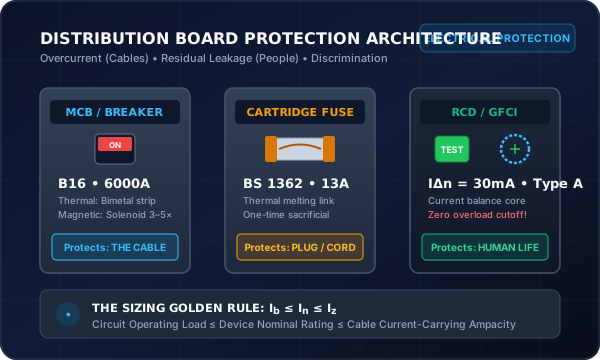
The kettle goes on while the toaster is still running, and the kitchen goes dark. Or the water heater starts up and a breaker in the panel clicks off. When a circuit keeps tripping, someone will usually suggest fitting a bigger breaker. That is the one fix you should not make: an oversized breaker lets the wire overheat before anything trips, and that is how conductor insulation melts, terminals burn and fires start inside walls.
A distribution panel is not a random collection of switches. Every protective device inside it has one specific mechanical job, and none of them can do the work of the others. A miniature circuit breaker does not care if current is trickling through your body into the bathroom floor, and a standard residual current device will sit quietly while your wiring cooks until the PVC catches fire.
In this guide, we will step through what each device physically protects, how to calculate the real operating current of your household appliances, how to sanity-check breaker and cable sizes using standard engineering rules, and how to spot when a trip is a lifesaving warning that requires a licensed electrician.
Contents in this Guide
- Three Devices, Three Different Jobs
- Safety First: Read All of This Before Touching the Panel
- How Much Current Does Your Circuit Actually Carry?
- Choosing a Breaker or Fuse Rating: The Sizing Sanity Check
- RCD and GFCI Basics: Sensitivity, Types, and Nuisance Tripping
- When Protection Trips: A Logical Order of Thinking
- Common Mistakes That Create Fire and Shock Hazards
- Interactive Calculators & Engineering Tools
- Frequently Asked Questions
Three Devices, Three Different Jobs
The most widespread misunderstanding in residential electricity is the belief that circuit breakers protect your appliances. They do not. If your refrigerator motor seizes or your blender develops an internal winding short, the breaker will not save the appliance; the appliance is already damaged.
Fuses and circuit breakers exist to protect the wiring hidden behind your drywall from getting hot enough to start a house fire. Residual Current Devices (RCDs) and Ground Fault Circuit Interrupters (GFCIs) exist to protect human beings from lethal cardiac arrest caused by current leaking through their chest to ground. Keeping that distinction clear is the starting point for every sensible electrical decision.
Fuses: The Sacrificial Metal Link
A fuse is the simplest and oldest form of overcurrent protection. Inside its ceramic or glass body sits a precisely calibrated piece of metal wire or stamped ribbon. When current exceeds the rated threshold for long enough, the metal reaches its melting temperature (I2R heating), vaporizes, and opens the circuit.
Because they physically disintegrate, fuses are one-time sacrificial devices. Once a fuse blows, you cannot flip a lever; you must replace it. While modern distribution boards in newly built homes use circuit breakers, fuses are still standard inside UK plug tops (BS 1362), consumer electronics power supplies, automotive fuse boxes, and heavy industrial service heads where their immense short-circuit breaking capacity (often exceeding 80,000 Amperes) remains unmatched by cheap breakers.
Circuit Breakers (MCBs): Resettable Thermal-Magnetic Switches
A Miniature Circuit Breaker (MCB) does the exact same job as a fuse, but it uses mechanical automation instead of a melting wire, allowing you to reset it once the issue is cleared. Modern MCBs contain two separate trip mechanisms working in tandem:
- The Thermal Mechanism (Bimetallic Strip): Handles slow, moderate overloads. When you run too many appliances, the sustained current heats two bonded strips of dissimilar metals. Because one metal expands faster than the other, the strip curves over dozens of seconds or minutes until it pushes the mechanical trip lever.
- The Magnetic Mechanism (Electromagnetic Solenoid): Handles short circuits. When line touches neutral directly, current jumps to hundreds or thousands of amperes within milliseconds. The strong magnetic field pulls in a plunger and snaps the contacts open, typically in under 20 milliseconds, before the wire can be damaged.
RCDs and GFCIs: The Current Balance Monitors
A Residual Current Device (known in the United States and Canada as a GFCI) does not care about overloads. You could draw 60 Amperes through a 16 A rated RCD, and as long as every milliampere returning on the neutral equals what went out on the line, the RCD will not trip at all.
An RCD works on Kirchhoff's Current Law using a high-permeability toroidal current transformer. Both the line conductor and neutral conductor pass through the center of this ring core. In a healthy circuit, the magnetic field produced by the outgoing line current is matched and cancelled by the incoming neutral current. The net magnetic flux in the core is exactly zero.
If water enters a toaster, or someone touches a frayed lawnmower cable, a small current (as low as 30 milliamperes) leaks through their body or the appliance casing directly into earth ground. Now, line current no longer equals neutral current. The resulting magnetic imbalance induces a voltage in a secondary sensing coil, triggering a sensitive relay that opens the circuit in under 40 milliseconds. That speed is what saves lives from fatal ventricular fibrillation.
RCBOs and AFCIs: The Combined Evolutions
In modern consumer units, electricians increasingly install RCBOs (Residual Current Breaker with Overcurrent protection). An RCBO combines an MCB and an RCD inside a single modular DIN-rail housing. It defends the circuit against overcurrent, dead short circuits, and earth leakage simultaneously. This eliminates the headache of older split-load boards where one leaking appliance would trip half the house.
In North American homes governed by the National Electrical Code (NEC), you will also encounter AFCIs (Arc-Fault Circuit Interrupters). An AFCI incorporates an onboard microprocessor that samples the AC current waveform. It detects the unique high-frequency electrical noise characteristic of arcing: loose screw terminals sparking behind wall plates, cords chewed by pets, or screws driven through cables during picture hanging.
| Device Type | What It Protects | Trips On | Does NOT Protect Against | Typical Rating | Where You See It |
|---|---|---|---|---|---|
| Fuse | Cable, cord, or appliance internals | Sustained overload & dead short circuits (I²R heat) | Earth leakage shocks; micro-arcing; low-level ground faults | 3 A, 5 A, 13 A (plugs); 30 A to 100 A (mains) | Plugs, electronics power inputs, vintage boards, service heads |
| Circuit Breaker (MCB) | Downstream building wiring | Thermal overload (bimetal) & short circuit (magnetic) | Electric shocks to earth; neutral-to-earth leakage; small arcs | 6 A, 10 A, 16 A, 20 A, 32 A, 40 A (or 15 A, 20 A US) | Distribution boards, consumer units, breaker panels |
| RCD / GFCI | Human life and earth fire hazards | Line-to-neutral current imbalance (earth leakage) | Overloads! A 100 A short between line and neutral won't trip it | 16 A to 63 A load; 30 mA sensitivity (4–6 mA for US GFCI) | Whole-house RCD modules, bathroom/kitchen GFCI sockets |
| RCBO | Building wiring AND human life | Overload, short circuit, and earth leakage combined | Series arcing across loose screw terminals (unless AFDD rated) | 6 A to 32 A load with 30 mA earth leakage trip | Modern residential panels with dedicated circuit isolation |
| AFCI / AFDD | Building structure from arc fires | High-frequency sputtering arcing signatures | Does not replace 30 mA whole-body shock protection by itself | 15 A, 20 A (US/NEC); 16 A (IEC AFDD standards) | US bedroom/living room circuits; high-risk IEC installations |
Safety First: Read All of This Before Touching the Panel
A residential breaker panel or consumer unit contains exposed copper busbars connected directly to the utility transformer in the street. Flipping the main service switch or branch breakers OFF only de-energizes the load terminals; the incoming supply terminals and line lugs stay live with deadly energy. Touching a tool or your hand to an incoming busbar can deliver a fatal shock or trigger an arc flash blast hot enough to vaporize copper and cause third-degree burns. Never remove the panel dead-front cover. Panel interior work belongs exclusively to licensed, certified electricians.
Removing a panel cover to tighten a screw or swap a breaker is a classic way to get hurt. If a screwdriver slips across the service lugs, the result can be an arc flash that melts the tool, wrecks the panel and causes severe burns. Treat the panel as live unless a qualified electrician has isolated the supply upstream.
This guide is an educational and load-calculation resource, not a panel installation manual. Knowing how to calculate loads and understand what is in your panel helps you manage your appliances intelligently and talk to your electrician with clarity. It does not qualify you to land conductors or replace breakers.
What a Homeowner Can Safely Do
You do not need an electrical license to take sensible, non-invasive steps outside the panel cover:
- Resetting a Tripped Breaker: If a circuit trips, switch off and unplug the appliance you just turned on. Push the breaker handle firmly to the OFF position first to reset the internal trip spring, then push it back to the ON position. If it trips immediately, do not force it; leave it off.
- Testing the RCD or GFCI Monthly: Press the mechanical test button on the face of your RCD or GFCI receptacle. The switch should click off instantly. Reset it to restore power.
- Auditing Your Circuit Labels: Map out which wall sockets and light fittings belong to which breaker number. Turn off one breaker from the exterior handle, walk the house with a lamp or nightlight, and write down every socket that lost power.
- Checking Socket Polarity: Use an inexpensive three-light plug-in socket tester on wall receptacles to verify correct line, neutral, and earth wiring without opening anything.
What Belongs Exclusively to a Licensed Electrician
Call a qualified professional whenever the work involves physical access behind the protective cover:
- Removing the metal dead-front panel cover or touching busbars.
- Swapping an existing breaker for a different current rating or brand.
- Pulling new cables, adding branch circuits, or installing new wall outlets.
- Investigating breakers that feel hot to the touch or make buzzing sounds.
- Diagnosing circuits that trip with nothing plugged in.
Warning Signs That Demand Immediate Professional Attention
Electricity usually gives you warnings before it starts a fire, but only if you know what to look for. If you notice a faint smell of fish or scorched plastic near an outlet or the breaker box, that is overheated phenolic resin and wire insulation breaking down. Turn the circuit off at the panel immediately.
Similarly, if an outlet faceplate is discolored brown or feels warm to your hand, the spring tension inside the receptacle has relaxed, creating high contact resistance. If a breaker buzzes like a horn under load, or if an RCD will not stay set even when every plug in the house is pulled from the walls, stop experimenting. Turn off the main switch if safe to do so, and call a professional.
The Lethal Fallacy: Why You Must Never "Just Fit a Bigger Breaker"
When a 16 A breaker keeps tripping because a family runs two space heaters in the winter, the easiest temptation is to replace the 16 A breaker with a 25 A or 32 A unit. That is the electrical equivalent of disabling the smoke detector because the alarm is too noisy.
The breaker is intentionally sized to be the weakest link in the electrical chain. If your wall is wired with 1.5 mm² (14 AWG) copper, that wire can safely carry around 15 to 18 Amperes in normal ambient conditions before its PVC insulation softens. If you fit a 32 A breaker, you can pull 28 Amperes continuously through that small wire. The breaker will happily ignore the overload, but the wire inside your wall will reach over 100°C (212°F), melting the insulation, charring the timber studs, and causing an in-wall fire that you cannot see until smoke billows from the baseboards.
The sizing principles and formulas presented here are strictly for educational and conceptual understanding. Electrical codes vary significantly across jurisdictions: the National Electrical Code (NFPA 70 / NEC) in the United States, the Canadian Electrical Code (CEC), BS 7671 in the United Kingdom, AS/NZS 3000 in Australia and New Zealand, and IEC 60364 across Europe and Asia each have distinct requirements for derating, grouping, earth fault loop impedance, and permitted protective devices. Always adhere to your local electrical code and obtain necessary municipal permits before undertaking work.
How Much Current Does Your Circuit Actually Carry?
Before you can understand whether a circuit breaker is appropriately sized, you have to know how much current the connected appliances pull through the wire. Fortunately, the basic physics comes down to one straightforward formula derived from Ohm's Law and the electrical power equation.
Single-Phase Current Formula
I = P / V
Where I is current in Amperes (A), P is active power in Watts (W), and V is supply voltage in Volts (V). For purely resistive loads like kettles, heaters, and incandescent bulbs, this formula gives the exact current. For motors and inductive loads with a power factor (PF < 1.0), current is calculated as I = P / (V × PF).
Reading Appliance Nameplates
Every certified electrical appliance has an aluminum or stamped plastic rating label, usually located near the cord entry or on the underside of the chassis. Look for two numbers: voltage (e.g., 220-240V ~ 50Hz or 120V ~ 60Hz) and power consumption (e.g., 2000W or 10A).
If the plate gives watts, divide by your mains voltage to find the amps. If the plate gives volt-amperes (VA), as on computer uninterruptible power supplies (UPS) or microwave transformers, that represents apparent power, which already accounts for power factor: simply divide VA by voltage to find the operating current.
Simultaneous Load vs. Connected Load (Diversity)
If you walk through your kitchen and add up the wattage of the oven, dishwasher, microwave, toaster, kettle, coffee maker, and refrigerator, the total might reach 12,000 Watts (over 50 Amperes at 230 V). Does that mean your kitchen requires a 50 A breaker and industrial submarine cable?
No. Electricians distinguish between total connected load (everything that could theoretically be turned on) and simultaneous operating load. In residential engineering, we apply what standards call diversity: the statistical reality that you will not be boiling a kettle, running the microwave, baking a roast, and cycling the dishwasher at the exact second you push down the toaster lever. However, high-draw heat appliances sharing a single wall circuit will easily collide if you are not mindful of what is plugged in.
Continuous Loads and the 80% Rule
A load that runs continuously behaves very differently from an intermittent load. When current flows through a breaker, the internal bimetallic strip absorbs heat. If the circuit runs for hours without stopping, that thermal buildup can trip a fully loaded breaker even if it never technically exceeds its marked rating.
The North American NEC Standard: Under US NEC Article 210.20, a continuous load is defined as any load where the maximum current is expected to continue for 3 hours or more (such as electric vehicle chargers, space heaters, or commercial store lighting). The code mandates that the protective device rating must not be less than 125% of the continuous load. Inverted, this means you can only load a standard branch circuit breaker to 80% of its rated current for continuous duty. A standard 15 A breaker has a safe continuous ceiling of 12 A (1,440 W at 120 V), and a 20 A breaker has a continuous ceiling of 16 A (1,920 W at 120 V).
The IEC Standard (UK, Europe, International): In IEC 60364 and UK BS 7671 design practice, continuous loading is addressed during cable thermal calculations through the fundamental sizing inequality:
Ib ≤ In ≤ Iz
Here, Ib is the circuit design current, In is the nominal rating of the protective breaker, and Iz is the current-carrying capacity of the cable under its specific installation method and ambient conditions.
Worked Example 1: The 230 V Kitchen Collision
Consider a typical modern kitchen circuit in Europe, the UK, or Australasia supplied at 230 V. On one double outlet, someone plugs in a 2,400 W rapid-boil kettle and a 1,200 W 4-slice toaster.
- Kettle Operating Current: Ikettle = (2,400 W) / (230 V) = 10.43 A
- Toaster Operating Current: Itoaster = (1,200 W) / (230 V) = 5.22 A
- Total Simultaneous Draw: Itotal = 10.43 A + 5.22 A = 15.65 A
If this radial circuit is protected by a 10 A breaker (common on older lighting or light utility lines), the breaker will trip within seconds. If it is on a standard European 16 A breaker, the load sits at 15.65 A (97.8% of rating). The bimetal strip will warm up, and while it might hold for the two minutes it takes to boil water, adding a 300 W food processor to that circuit will trip the breaker reliably.
Worked Example 2: The 120 V Space Heater Trap
Now take a bedroom in North America supplied at 120 V on a standard 15 A general branch circuit. A tenant buys an 1,800 W portable ceramic space heater to stay warm in January.
- Heater Current Draw: I = (1,800 W) / (120 V) = 15.00 A
- Breaker Rated Limit: Exactly 15.00 A (100% load)
- NEC 80% Continuous Limit: 15 A × 0.80 = 12.00 A (or 1,440 W)
Because space heaters run for hours continuously, pulling 15 A through a 15 A thermal-magnetic breaker will heat the internal trip mechanism and it may trip after a while. The breaker is not broken; it is doing exactly what it was designed to do to prevent heat buildup inside wall junction boxes.
Check Your Circuit Load Before You Plug In
Calculate total circuit Amperes, check safe 80% continuous limits, and find the appropriate standard breaker size for 120 V and 230 V systems with our interactive Ohm's Law and Breaker Load tools.
Choosing a Breaker or Fuse Rating: Sizing Sanity Check
Selecting a breaker rating is never a guessing game. It follows one non-negotiable rule respected by every electrical code on Earth:
The protective device rating (In) must be greater than or equal to the normal operating load (Ib), but strictly less than or equal to the safe continuous current capacity of the installed cable (Iz). In short: Load ≤ Breaker ≤ Cable. If you violate this chain by increasing the breaker without increasing the cable, you remove the circuit's thermal protection.
Cable Size vs. Typical Breaker Ratings
Conductors have resistance. When current passes through copper, heat is generated (P = I2R). The maximum current a wire can carry before its insulation exceeds its temperature rating (typically 70°C for standard PVC or 90°C for XLPE/THHN) depends on cross-sectional area, ambient temperature, whether it runs through thermal insulation, and how many other wires share the same conduit.
The table below illustrates typical conservative pairings for standard residential copper conductors in normal ambient temperatures. Treat these as a benchmark sanity check, not an installation design: local installation codes always take legal precedence.
| Cable Size (Metric / AWG) | Typical Breaker Rating (In) | Typical Circuit Application | Conservative Installation Notes |
|---|---|---|---|
| 1.5 mm² (~16 AWG) | 10 A – 16 A (or 15 A US) | Domestic lighting, ceiling fans, smoke detectors | Limited to 10 A in some IEC codes when enclosed in thermal wall insulation. |
| 2.5 mm² (~13 AWG) | 16 A – 20 A (or 20 A US) | General socket outlets, refrigerator, washing machine | Standard residential radial circuit wire across Europe and Commonwealth nations. |
| 4.0 mm² (~11 AWG) | 25 A – 32 A (or 30 A US) | Electric water heaters, high-power cooktop hobs, air con | Provides lower voltage drop over long distribution runs to outbuildings. |
| 6.0 mm² (~9–10 AWG) | 32 A – 40 A (or 40 A US) | Electric cookers, small instantaneous showers, heat pumps | Common supply for induction ranges and sub-panel feeder circuits. |
| 10.0 mm² (~7 AWG) | 50 A – 63 A (or 55 A US) | Instantaneous water heaters (8.5–10 kW), large EV chargers | Requires substantial terminal lugs; high thermal dissipation capacity. |
| 16.0 mm² (~5 AWG) | 63 A – 80 A (or 70–85 A US) | Sub-panel distribution feeders, main domestic incomers | Heavy feeder cable; bend radius and conduit fill must be verified. |
Trip Curves B, C, and D: Handling Inrush Without Nuisance Trips
Have you ever noticed your living room lights blink for a split second when a large vacuum cleaner, refrigerator compressor, or table saw starts up? That dip is caused by inrush current. For a few alternating-current cycles (less than 100 milliseconds), an AC induction motor draws between four and eight times its normal running current while establishing its magnetic field.
If every breaker tripped instantly the moment current exceeded its faceplate rating, you could never turn on a power tool or air conditioner. That is why international standards (IEC 60898-1) classify breakers into standardized trip curves. The letters B, C, and D designate how many times nominal current (In) must flow before the magnetic instantaneous solenoid fires.
| Trip Curve | Magnetic Instantaneous Trip Multiplier | Typical Residential & Light Commercial Uses | Electrician's Field Recommendation |
|---|---|---|---|
| Type B | 3× to 5× In (e.g., 48 A to 80 A for a 16 A MCB) |
Resistive loads: domestic lighting, electric heaters, kettles, toasters | Standard choice in domestic UK/EU installations with long cable runs and high earth loop impedance. |
| Type C | 5× to 10× In (e.g., 80 A to 160 A for a 16 A MCB) |
General socket circuits, refrigerators, heat pumps, air compressors, power tools | The worldwide workhorse for general power. Absorbs motor starting surges without nuisance tripping. |
| Type D | 10× to 20× In (e.g., 160 A to 320 A for a 16 A MCB) |
High-inrush industrial equipment: heavy welding sets, large transformers, x-ray units | Rarely used in domestic settings. Requires very low earth loop impedance to ensure disconnection before cable burns. |
Breaking Capacity (kA): What Keeps the Breaker from Exploding
Next to the current rating on an MCB faceplate, you will spot a number printed inside a tiny rectangle: usually 6000 or 10000 (or 6 kA / 10 kA). This is the breaker's rated breaking capacity.
If you accidentally drive a nail straight through a line and neutral conductor right next to the main panel, the resistance of the fault is almost zero. For a split second, the utility transformer will dump thousands of Amperes into that arc. The breaking capacity indicates the maximum prospective short-circuit current the breaker can safely extinguish without its internal arc chute blowing apart or the contacts welding shut permanently. Domestic breakers are commonly rated 6 kA, and 10 kA or more is used where the available fault current is higher. Your electrician checks this against the supply at your premises.
Voltage Drop on Long Circuit Runs
A breaker might be rated correctly for the wire size, but if that cable runs 40 meters (130 feet) out to a detached garage or garden workshop, conductor resistance causes significant voltage drop. When voltage drops under load, motor currents increase, and available fault current decreases, which can prevent the breaker's magnetic trip from firing fast enough during a short circuit. For runs exceeding 20 meters, always evaluate voltage drop using our Voltage Drop Calculator and consider increasing cable cross-section.
Worked Example 3: Sizing for a 3,000 W Electric Water Heater
You are planning the dedicated radial supply for a 3,000 W unvented storage water heater on a 230 V single-phase supply.
- Operating Load: I = (3,000 W) / (230 V) = 13.04 A
- Selecting Device Rating (In): Standard breaker sizes are 10 A, 16 A, 20 A, and 32 A. A 10 A breaker would trip immediately. The next standard size above 13.04 A is 16 A.
- Checking the Cable (Iz): A 2.5 mm² copper cable clipped direct has an ampacity exceeding 24 A (well above 16 A). The chain holds true: 13.04 A ≤ 16 A ≤ 24 A. A 16 A Type B or Type C breaker paired with 2.5 mm² cable is the sound engineering choice.
Worked Example 4: Sizing for a 1.5 kW Induction Pump Motor
Now consider a 1.5 kW (1,500 W mechanical output) single-phase well pump motor operating at 230 V. Because motors are inductive, we must account for power factor (typically 0.80 for a running induction motor).
- Running Current: Irun = (1,500 W) / (230 V × 0.80) = 1,500 / 184 ≈ 8.15 A
- Starting Inrush Surge: During starting, the motor pulls roughly 5× to 6× running current: 8.15 A × 6 ≈ 48.9 A for the first 80 milliseconds.
- Selecting the Breaker: A 10 A Type B breaker would enter its magnetic trip range between 30 A and 50 A (3× to 5×), creating frequent nuisance trips when the pump starts up. A 10 A or 16 A Type C breaker (which holds until 5× to 10×, or 50 A to 100 A) allows the pump to start smoothly while still protecting the motor circuit from sustained overload.
RCD and GFCI Basics: Sensitivity, Types, and Testing
If circuit breakers are the guardians of your property and building framing, RCDs and GFCIs protect people. Standard household voltages can push deadly current through human skin. Currents of a few tens of milliamperes through the body can cause ventricular fibrillation, and the risk rises with current and duration.
What 30 mA Actually Means
In countries following IEC standards, the benchmark threshold for residential life safety is 30 mA (0.03 A) with a disconnection time under 40 milliseconds. Why 30 mA? IEC 60479-1, which describes the effects of current on the human body, is the basis for this figure: below about 30 milliamperes the risk of ventricular fibrillation is low for adults, although it is not zero and depends on how long the current flows.
You will also encounter RCDs rated at 100 mA or 300 mA (often labeled "Time Delayed" or "Type S"). These devices are installed at the main service entrance not for personal shock protection, but for fire protection and circuit selectivity. A high-resistance arc between a chafed line cable and a grounded metal conduit pulling 200 mA will not trip an MCB, but it will easily spark a wall fire. A 300 mA RCD catches this fault and disconnects the building before ignition occurs.
The North American Difference: In the United States and Canada, standard receptacle-type GFCIs (UL 943 Class A) are calibrated to trip at a much lower threshold: 4 to 6 milliamperes. This provides an even higher margin of protection for individual wet-location branch outlets in bathrooms and kitchens.
Modern RCD Types: AC, A, F, and B
Fifty years ago, household appliances were purely linear: incandescent lamps, simple heating elements, and copper-wound motors. Today, modern homes are filled with switch-mode power supplies, variable-speed heat pump inverters, LED dimmers, and electric vehicle onboard chargers. These devices distort the AC sine wave and can inject direct current (DC) components into the electrical wiring.
- Type AC: Detects only purely sinusoidal alternating earth-leakage currents. In many European jurisdictions, Type AC is now prohibited in new residential installations because DC leakage can saturate the internal magnetic core, "blinding" the RCD and preventing it from tripping during a genuine shock!
- Type A: Detects standard sinusoidal AC leakage plus pulsating DC leakage currents. This is the minimum recommended standard for modern homes with computers, televisions, and induction cookers.
- Type F & Type B: High-specification units capable of detecting high-frequency leakage from brushless washing machine motors, variable-frequency drives, and photovoltaic solar inverters. EV chargers typically require Type B or Type A with dedicated 6 mA DC detection.
The Monthly Test Button
Every RCD, RCBO, and GFCI features a small mechanical push button labeled T or TEST. When you press this button, it connects a precision internal resistor between the line terminal on one side and the neutral terminal on the other, bypassing the sensing transformer core. This creates an artificial leakage current large enough to trip the device.
Pressing the test button proves that the sensing solenoid, mechanical spring latch, and contacts move freely. It does not prove that your external earth rod has low resistance, or that your wall socket earth pins are wired correctly. Always press this button every month to ensure the mechanical spring has not seized from dust or contact oxidation.
Why an RCD Trips for No Obvious Reason
Nuisance tripping is a common annoyance. If your RCD clicks off randomly with no apparent short circuit, suspect one of these four field causes:
- Cumulative Background Leakage: Modern electronics (PCs, smart TVs, LED drivers) contain internal electromagnetic interference (EMI) filters with capacitors linked to earth. Each appliance might leak 1 to 2 mA normally. If you have twenty IT devices sharing a single 30 mA RCD, the baseline leakage sits at 24 mA: one extra toaster clicking on can push it past the trip threshold.
- Exterior Moisture Ingress: Rainwater penetrating an outdoor security floodlight, garden water fountain pump, or weathered exterior socket creates a tiny leakage path straight to ground.
- Failing Sheathed Heating Elements: As electric oven elements, water heaters, and washing machine immersion rods age, their outer metal sheath develops microscopic fissures, allowing water to contact the internal magnesium oxide insulation.
- Neutral-to-Earth Faults: If a neutral wire touches an earth ground somewhere in the house, current from other active circuits can flow back through the earth path, tripping the RCD even when the breaker for that specific room is switched off!
How to Safely Isolate an RCD Leakage Fault
If your RCD trips and refuses to stay set, follow this systematic, non-invasive process:
- Step 1: Switch off all branch MCBs protected by that RCD.
- Step 2: Reset the RCD lever (it should stay up now with all branch breakers open).
- Step 3: Switch on the branch MCBs one by one until the RCD trips. You have now identified the faulty circuit.
- Step 4: Turn that faulty breaker back off, reset the RCD, and power up the rest of the house.
- Step 5: Walk to the suspect room, physically unplug (do not just switch off) every appliance from the wall. Reset the breaker. If it holds, plug appliances back in one at a time until the fault triggers. If the circuit trips with every single plug pulled out of the wall, the fault is inside the building wiring: call a licensed electrician.
When Protection Trips: A Logical Order of Thinking
When you stand in front of a dark distribution board, panic solves nothing; logic does. The nature of the trip tells you almost everything you need to know about what kind of fault just occurred.
| Symptom | Most Likely Cause | Safe First Step (Homeowner) | When to Call an Electrician |
|---|---|---|---|
| Breaker trips instantly with a loud pop when switched on | Dead short circuit between line and neutral (or line to earth) | Leave the breaker OFF. Unplug any appliance that was just plugged in or dropped. | If the breaker still trips with zero appliances connected, call an electrician immediately. |
| Breaker trips only after 10 to 30 minutes of running | Circuit overload (I2R thermal bimetal heating) | Unplug secondary high-draw appliances (heaters, kettles) sharing that room circuit. | If the breaker trips with only a single modest appliance running, the breaker or circuit is compromised. |
| RCD trips immediately when reset; holds with all MCBs off | Earth leakage fault on a specific branch circuit | Perform branch isolation: flip MCBs on one by one to identify the faulty room. | If the faulty circuit trips the RCD with all appliances unplugged (neutral-to-earth short). |
| RCD trips randomly during rainfall or high humidity | Moisture ingress into outdoor lighting, patio sockets, or conduit | Inspect outdoor lights and receptacles for visible water condensation or damaged seals. | When exterior junctions are sealed and the ground leakage persists. |
| Breaker faceplate feels warm or emits a faint buzzing sound | Loose terminal screw clamp or internal contact erosion | Shut off the breaker immediately to prevent terminal carbonization and arcing. | Always! A warm breaker requires immediate inspection and replacement by a professional. |
| Lights dim dramatically when a large motor or compressor starts | Excessive circuit voltage drop or undersized service feeder | Avoid running multiple high-draw appliances simultaneously on that sub-panel feeder. | If dimming exceeds 5–10% or is accompanied by flickering and buzzing panel lugs. |
| Acrid burning smell near the panel or wall socket | Active terminal arcing or melted conductor insulation | Turn off the main panel isolator switch immediately if safe to approach. | Emergency situation. Contact a licensed electrician or emergency electrical service immediately. |
Overload vs. Short Circuit vs. Earth Fault in Plain Language
To recap the three core electrical failures: An overload is simply asking a healthy pipe to carry more water than it can handle; it takes time to heat up and trip. A short circuit is a sudden catastrophic structural rupture where zero-resistance line and neutral conductors touch, drawing hundreds of Amperes in milliseconds. An earth fault is an unauthorized escape of current trickling off through an unintended pathway, like metal framing or living human tissue.
Common Mistakes That Create Fire and Shock Hazards
The same dangerous improvisations come up again and again in home wiring. These are the ten most hazardous shortcuts:
- Upsizing the Breaker Rating: Swapping a 16 A breaker for a 25 A unit because the kitchen trips when baking and boiling water. The hidden cable in the wall will overheat and destroy its insulation before the new breaker ever reacts.
- Bridging Fuses with Wire or Foil: Wrapping aluminum cigarette foil or thick copper wire around a blown cartridge fuse. This completely disables overcurrent protection and turns the fuse holder into a fire risk.
- Taping or Wedging Breaker Handles: Mechanically taping an MCB toggle into the ON position. Quality modern breakers have a "trip-free" mechanism that drops the internal contacts even if the external handle is held up, but force-wedging stresses internal springs and increases fire hazards.
- Daisy-Chaining Multi-Outlet Power Strips: Plugging one power strip into another to reach an entertainment center or workshop bench. The wall outlet sees the compounded load of everything attached, creating severe heating at plug pin contacts.
- Using Flexible Extension Cords as Permanent Wiring: Running lightweight 0.75 mm² (18 AWG) extension leads under carpets, across doorways, or through attic crawlspaces. Extension leads are rated for temporary use only; foot traffic abrades the jacket, leading to short circuits.
- Ignoring Warm Plugs or Discolored Sockets: Treating a yellowed, warm wall plate as normal cosmetic aging. Warmth is definitive evidence of high-resistance electrical connections generating dangerous local heat.
- Mixing Copper and Aluminum Wire Improperly: Splicing older aluminum branch conductors to modern copper fittings using standard wire nuts. The dissimilar metals expand at different rates and undergo galvanic corrosion, creating loose, sparking joints unless specialized antioxidant compound and rated connectors are used.
- Installing Mismatched Breaker Brands in a Panel: Forcing a Square D, Siemens, or Schneider breaker into an incompatible load center. Breaker mounting stabs and busbars are engineered to proprietary tolerances; a loose bus connection can cause catastrophic electrical panel fires.
- Assuming a 'Surge Strip' Protects Against Overloads: Believing a common consumer surge protector is a circuit breaker. While some have tiny 10 A thermal trip buttons, their primary function is absorbing voltage spikes, not regulating continuous wire ampacity.
- Resetting Breakers Repeatedly Without Investigating: Flipping a tripped breaker back ON three or four times in a row against an active short circuit. Each reset forces the breaker contacts to interrupt thousands of Amperes, degrading internal arc chutes and increasing arc explosion risks.
Frequently Asked Questions
What is the difference between a fuse and a circuit breaker?
Both devices protect downstream cables from overloads and short circuits. A fuse relies on a sacrificial metal wire that melts when excess current passes through it, requiring replacement once blown. A circuit breaker uses a bimetallic strip for slow thermal overloads and an electromagnetic solenoid for instantaneous short-circuit protection, allowing you to reset it with a toggle switch once the fault is cleared.
What does an RCD or GFCI actually do?
A Residual Current Device (RCD), known as a Ground Fault Circuit Interrupter (GFCI) in North America, monitors the balance between line and neutral currents. If current leaks to earth through damaged insulation, moisture, or a person touching a live wire, the device disconnects the circuit in under 40 milliseconds. It protects human life from fatal ventricular fibrillation but does not limit total circuit current or overload.
Why does my circuit breaker keep tripping?
A breaker trips for three primary reasons: an overload (running too many appliances simultaneously on one cable), a dead short circuit (a hot conductor contacting neutral or earth), or internal component fatigue. If it trips after running appliances for ten minutes, it is likely an overload. If it trips with a loud pop the instant you flip the switch, suspect a short circuit.
Can I replace a 16 A breaker with a 20 A breaker so it stops tripping?
Never upsize a protective device without verifying conductor cross-section, installation method, derating factors, and local regulations. A breaker rating protects the hidden cable behind your wall. If you install a 20 A breaker on a circuit wired with 1.5 mm² (14 AWG) cable rated for only 16 A, the cable will overheat and ignite before the breaker trips. Always consult a licensed electrician.
What size breaker do I need for a 3,000 W electric water heater?
On a standard 230 V European or Australasian single-phase supply, a 3,000 W resistive heater draws 13.04 Amperes (3,000 / 230). The standard commercial rating is a 16 A Type B or Type C breaker, wired with minimum 2.5 mm² copper cable. On a 120 V circuit, a 3,000 W load would draw 25 A, requiring a dedicated 30 A 240 V circuit instead.
Is a GFCI the exact same thing as an RCD?
Functionally, yes: both detect current imbalance between line and neutral. However, their trip thresholds differ by regional standard. North American Class A GFCIs trip at 4 to 6 milliamperes for individual receptacle safety. IEC-standard RCDs used in the UK, Europe, Australia, and Asia typically trip at 30 milliamperes for whole-circuit personal protection.
How often should I test my RCD or GFCI test button?
Electrical safety authorities worldwide recommend pressing the mechanical test button once every month (or at minimum every six months during seasonal clock changes). Pressing the test button introduces an artificial internal leakage current to verify the mechanical trip latch still moves freely and has not seized from dust or contact welding.
Why does my RCD trip when it rains or during humid weather?
Moisture ingress into outdoor lighting fixtures, exterior weather-resistant socket boxes, patio heat lamps, or subterranean conduit paths creates high-resistance leakage paths between live conductors and earth. Even a tiny trickle of 30 milliamperes through damp dust or water droplets will trip an RCD immediately.
When the Breaker Trips Again
When a circuit trips, do not just flip the handle straight back up. Spend ten seconds working out what you turned on, unplug the high-draw appliance, and check whether the breaker faceplate feels unusually hot before you reset it.
Never upsize a breaker to hide a tripping circuit, and never bypass an RCD that will not stay set. Both devices exist to protect the wiring and the people using it. Keep your loads within sensible margins, and when in doubt, leave the panel alone and call a licensed electrician. The Ohm's Law and Circuit Load calculator can help you estimate loads before you plug more in.